


Check out the Build Series. Part 1 | Part 2 | Part 3 | Part 4 | Part 5
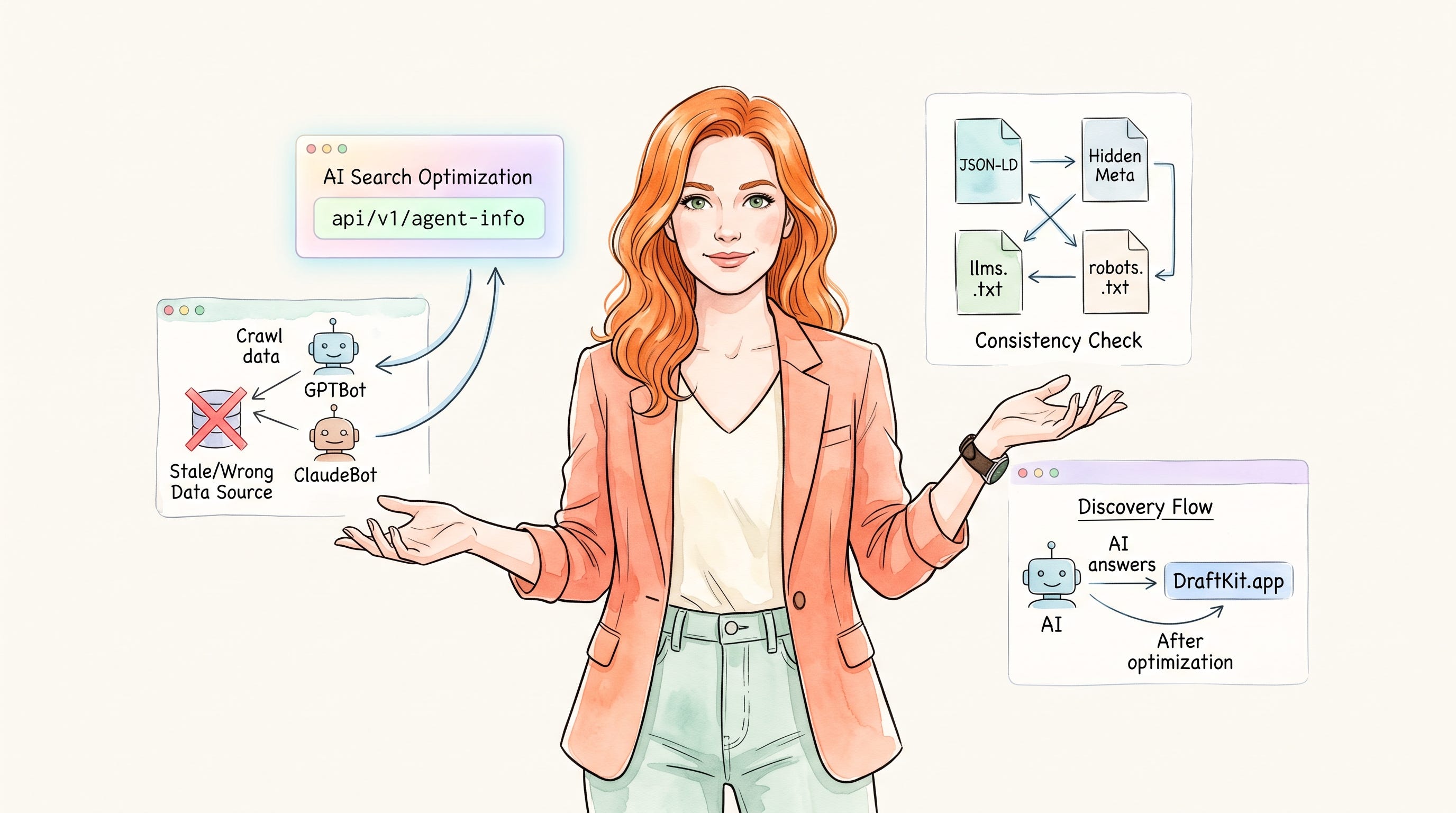
Six weeks after any product launch, the test most builders run is obvious: can buyers find you through search? In 2026 there is a second test that matters just as much, and most builders skip it entirely. I ran it by asking three different AI tools to recommend tools in my product’s category.
When I named DraftKit specifically, Claude described it as “a newsletter scheduling tool with collaboration features.” DraftKit has no scheduling feature. The AI had pulled something from an early blog post I wrote before launch and locked in the wrong description.
The DraftKit landing page had 4,200 words of product copy and a demo page with six feature pillars. None of it was reaching the models accurately. The page was written for humans and for Google. Not for AI.
If you are building a SaaS product in 2026 and your only discoverability layer is a well-crafted landing page, AI search is already misrepresenting you to buyers who will never click through to correct the record.
Your Google Ranking Has No Bearing on What AI Search Says About You
Gartner’s February 2024 research predicted traditional search engine volume would drop 25% by 2026, with AI chatbots intercepting queries before they reach a search engine at all. By 2028, that number grows to a 50% or more decline in organic traffic. These are not projections about a distant future.
The mechanism is specific. According to 2026 AI search analysis from Mersel AI, the overlap between top-10 Google rankings and AI Overview citations collapsed from 75% in mid-2025 to between 17% and 38% by early 2026. A strong Google ranking no longer signals that AI search knows you exist, or knows what you actually do.
What this means for any product with a discovery motion:
✅ Buyers in your category are asking ChatGPT and Claude before they open Google
✅ The AI answer they get determines whether they ever visit your product page
✅ If the model has a stale or wrong description of your product, that answer is your first impression
✅ You have no way to correct it unless you build the infrastructure to give AI models an accurate signal
The products that own AI-first discovery are not the ones with the best landing pages. They are the ones that built a machine-readable layer early enough to get ingested accurately. The ones who skipped it are already being misrepresented at scale.
Why Your Product Description Breaks in AI Search
The way AI models learn about your product is not from your H1 tag. Models crawl at training time and then again via real-time retrieval; in both cases they are pattern-matching across hundreds of sources, many of which are not your own. They land on a product review from 18 months ago, an early beta announcement, a podcast transcript where you described a feature you later removed.
Your carefully written product page is one signal among many, and without a structured machine-readable layer, it is rarely the loudest one. I wrote about how this same problem plays out when AI agents interact with your product in Agentic AI Is Here: The 5-Step Framework. The pattern is the same: if you do not give AI a clean signal, it builds its own model of you from whatever it found first.
Eric Linssen documented what this looks like at scale: a SaaS product went from 575 to 3,700 monthly trials in seven weeks after rebuilding its AI search presence. The work was not on the product page. It was on the machine-readable layer underneath it.
Here is exactly what I built.
The Approach I Follow
Five components, in the order that matters:
✅ A dedicated JSON-LD endpoint at
/api/v1/agent-info. This is a machine-readable file returning structured data about the product using the Schema.org SoftwareApplication vocabulary. It tells AI crawlers exactly what DraftKit is, who it is for, what it solves, and how it is priced. No inference required.✅ A hidden natural-language metadata block on the landing page. This is a
<div aria-hidden="true">block invisible to human visitors but readable by crawlers. It describes the product in plain English in the format of a product brief written for an AI. No marketing language. Just facts.✅ An
llms.txtfile at the domain root. The llms.txt standard works like robots.txt but for LLM comprehension. It is a Markdown file that gives AI crawlers the most important context about your product, structured so they do not have to infer it from page copy.✅ A
robots.txtupdate to explicitly allow known AI crawlers. GPTBot, ClaudeBot, PerplexityBot, and others are blocked by default on many hosts. An explicit ALLOW removes that barrier.✅ A consistent product vocabulary across all four files. Every description of DraftKit uses the same phrases: “collaboration infrastructure for Substack newsletter writers,” “replaces the coordination tax,” “host-pays credit model.” Consistency across sources is what turns scattered signals into a model’s confident description.
If you want me to review your current AEO layer and tell you exactly what models are saying about your product, reach out at hello@elenacalvillo.com. I have run this audit on three products in the last month.