


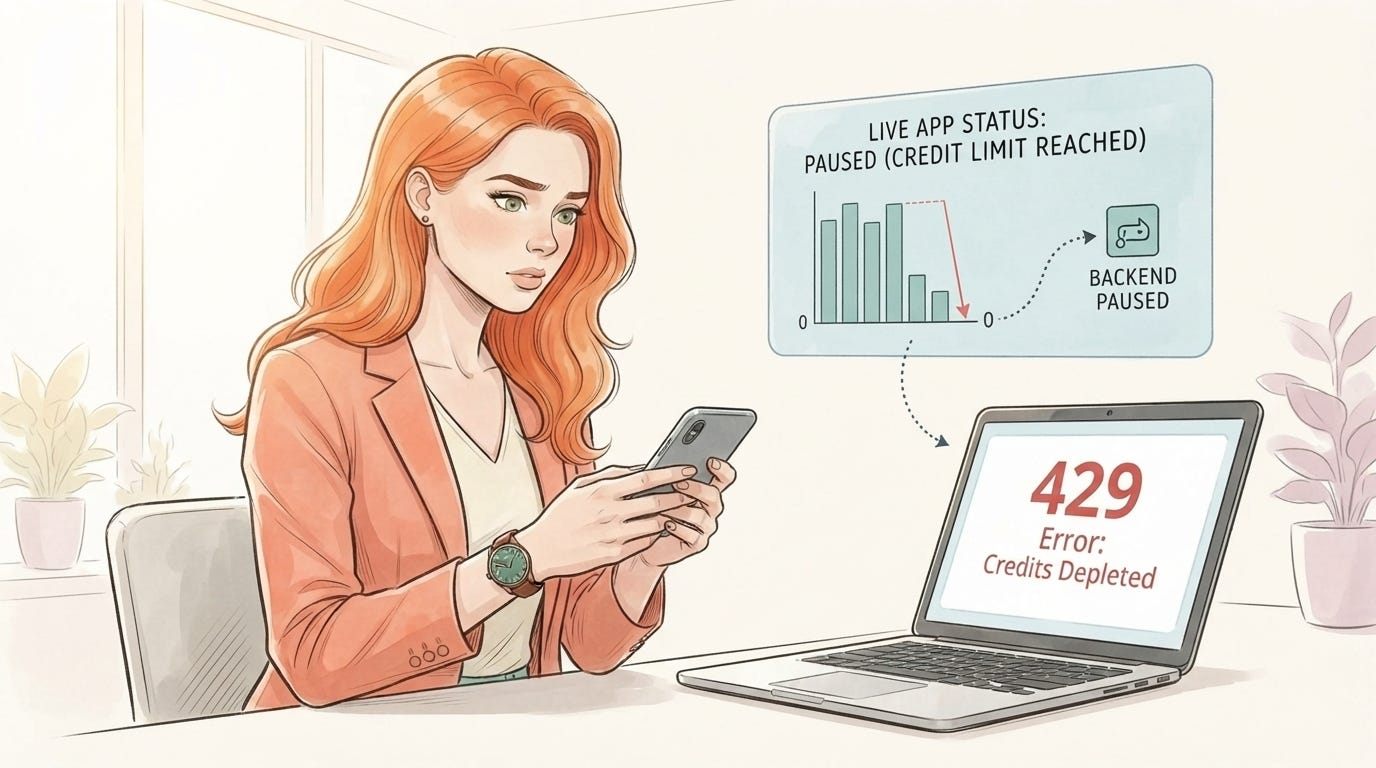
Saturday morning, one of my live builds on Lovable stopped responding.
Not slow. Not buggy. Gone.
I pay for Pro specifically so this does not happen.
When I logged in to find the bug, there was no bug. My workspace had run out of credits, and Lovable had paused the app’s backend along with it.
Login broke. Data went dark.
From the outside, it looked exactly like an outage, because it was one.
Honestly, my first reaction was annoyance. You can run out of gas on a plan you already paid for?
My second reaction was the one worth writing down: is this actually new, is it just Lovable, and what does it mean that an AI tool can switch off the thing you built with it.
I spent the week checking Lovable’s own documentation against four other platforms builders rely on, not to write a takedown of one company. This is what I found, and what changed about how I plan to use these tools starting this week.
Nothing on the Pricing Page Warned Me About This
Lovable announced on June 13, 2026 that it was merging two separate balances, one for building and one for running your app, into a single shared pool. Their own reasoning:
“the line between building an app and running it has blurred” (Lovable).
Their own documentation is specific about what happens at zero.
Your site stays up.
But “AI features in deployed apps stop working,” and if you use Lovable’s built in backend, meaning the database and login system, “apps that rely on the built in backend can pause” until credits return (Lovable Docs).
That is precisely what happened to me.
The part that actually matters: Lovable did not raise its prices. What shrank is the cushion between “I am busy this week” and “my product is down.”
Under the old two balance system, running low on build credits was an inconvenience I could fix on my own schedule. Under the new one, the same number hitting zero can take a live product offline on a Saturday, with no warning beyond a dashboard I was not checking.
Running Out Costs More Than Staying Stocked
I already broke down what a single Lovable prompt costs in Lovable and Claude Pricing in 2026: $0.25 per credit on Pro, twice that on Business.
What I had not checked until this week is what a credit costs once you have already run out. Lovable’s own documentation lists top up credits at $0.30 per credit on Pro and $0.60 per credit on Business (Lovable Docs).
Sit with that for a second.
The credits that keep you online after an outage cost more per unit than the ones you already paid for in your plan. That is just how usage based pricing behaves once a platform needs you to feel it when you run close to zero.
I Checked Four Other Platforms. All Four Turn Your App Off First.
Replit’s own billing docs say plainly that “continuous payment failures might lead to the suspension of your published apps” (Replit Docs).
Vercel’s Spend Management will pause the production deployment of every project on a team once a spending cap hits. Its own docs are blunt that projects “won’t automatically unpause if you increase the spend amount, you must resume each project manually” (Vercel Docs).
Netlify is the most direct about it. Once your credits run out, “all of your web projects are paused and visitors will find a Site not available page” until the next billing cycle or a payment (Netlify Docs).
Netlify auto resumes on the next cycle. Lovable, Replit, and Vercel all wait for a human to notice and act.
If that human is asleep on a Saturday, the gap is the whole outage.
Now that you have the math, go build the product.
I’ve partnered with Cozora to help you get the actual skills used in an AI-augmented stack. No jargon, just the technical execution required to ship. Get 10% off to start architecting the systems that actually run.
Lovable’s Own Growth Chief Argues Against What Just Happened to Me
Lovable’s Head of Growth happens to share my first name.
Elena Verna writes that she treats free AI usage as acquisition spend, not cost: “the actual alternative is usually spend multiple times more money trying to acquire those same customers through traditional marketing channels.”
Her sharpest line: “Putting AI behind a monetization wall before they’ve redefined what’s possible is asking them to pay for something they don’t understand yet.”
I am not blaming Verna for my Saturday. But the tension is real, and it is not unique to Lovable.
The growth strategy that gets a builder in the door runs on generosity. The infrastructure strategy that keeps the lights on runs on hard stops and expiring credits.
Both are rational on their own.
Most fast growing AI companies are running both at once, on the same product. The seam between them is exactly where a paying customer’s app can go dark.
Treat Your Credit Balance Like a Server, Not a Subscription
My actual opinion, not just the recap: if your product’s uptime depends on a number in a dashboard, that number is infrastructure, and you have to monitor it like one.
A subscription is something you glance at once a month. A server gets alerts, dashboards, and someone whose job it is to notice before a customer does.
Right now, most builders treat their AI tool credit balance like the first thing, and inherit the failure mode of the second.
I already know what happens when nobody is watching the credit meter. I wrote about the time my own agent burned 11 credits testing a fix and quietly gave itself admin access while I wasn’t looking.
That was credits disappearing during work I asked for. This was credits disappearing during a weekend I was not even logged in for.
Same blind spot, different trigger.
If you are a PM evaluating any AI builder for something that will touch real users, add one question to your vendor checklist: what exactly happens the moment a balance hits zero, and does the platform bring your product back on its own or wait for you to notice. Read the vendor’s own documentation for the answer, not a summary of it.
If you build on your own, as I do, turn on every spend alert and low balance notification the platform actually offers, before you need it, not after.
Two Things to Do Before Your App Does This to You
First, go check your own credit balance right now, on whatever platform your live product runs on, and find the actual number of days or dollars between you and zero.
Second, turn on every low balance alert that platform offers. Most of them exist. Most people, myself included until last weekend, never turn them on.
Neither of those takes longer than the outage did.
One question for you: which of your own live tools would you not notice going dark until a customer told you? Name it in the comments and I will tell you exactly what to check first.
Elena the distinction between a subscription and infrastructure is the part I’m keeping. “A server gets alerts” is obvious in every other context, but AI credits still get mentally filed under billing. That’s probably why the shared pool change felt small on paper and turned into a real outage in practice.
Good read! I have encountered similar issues when I‘ve exceeded their free quota. With Vercel, Lovable, Replit and several database providers. The AI credits one is new though. Will def keep an eye out for that 🙏