


Every Friday, product managers waste 2 hours writing reports stakeholders skim for 30 seconds. This prompt takes your raw Jira export or Slack summary and produces a 3-paragraph executive brief in under 10 minutes, structured around the only three questions stakeholders actually need answered.
I built this prompt while running product updates for DraftKit and AI Advent Challenge at the same time. Writing separate updates for different stakeholder groups was eating my Fridays whole. I’d pull tickets from Jira, dig through Slack threads for key decisions, and manually piece together something coherent. Two hours minimum, every single week.
The update wasn’t bad. The format was wrong. I was writing for someone with time to read a list. Stakeholders don’t want lists. They want a pulse.
The Prompt Logic
Traditional weekly updates are structured like status reports: tasks done, tasks blocked, tasks next. That format made sense when product managers were schedulers and coordinators.
In 2026, your stakeholders aren’t asking “what got done?” They’re asking three things: did we move the needle this week, did anything break or get risky, and what do you need from me before Thursday?
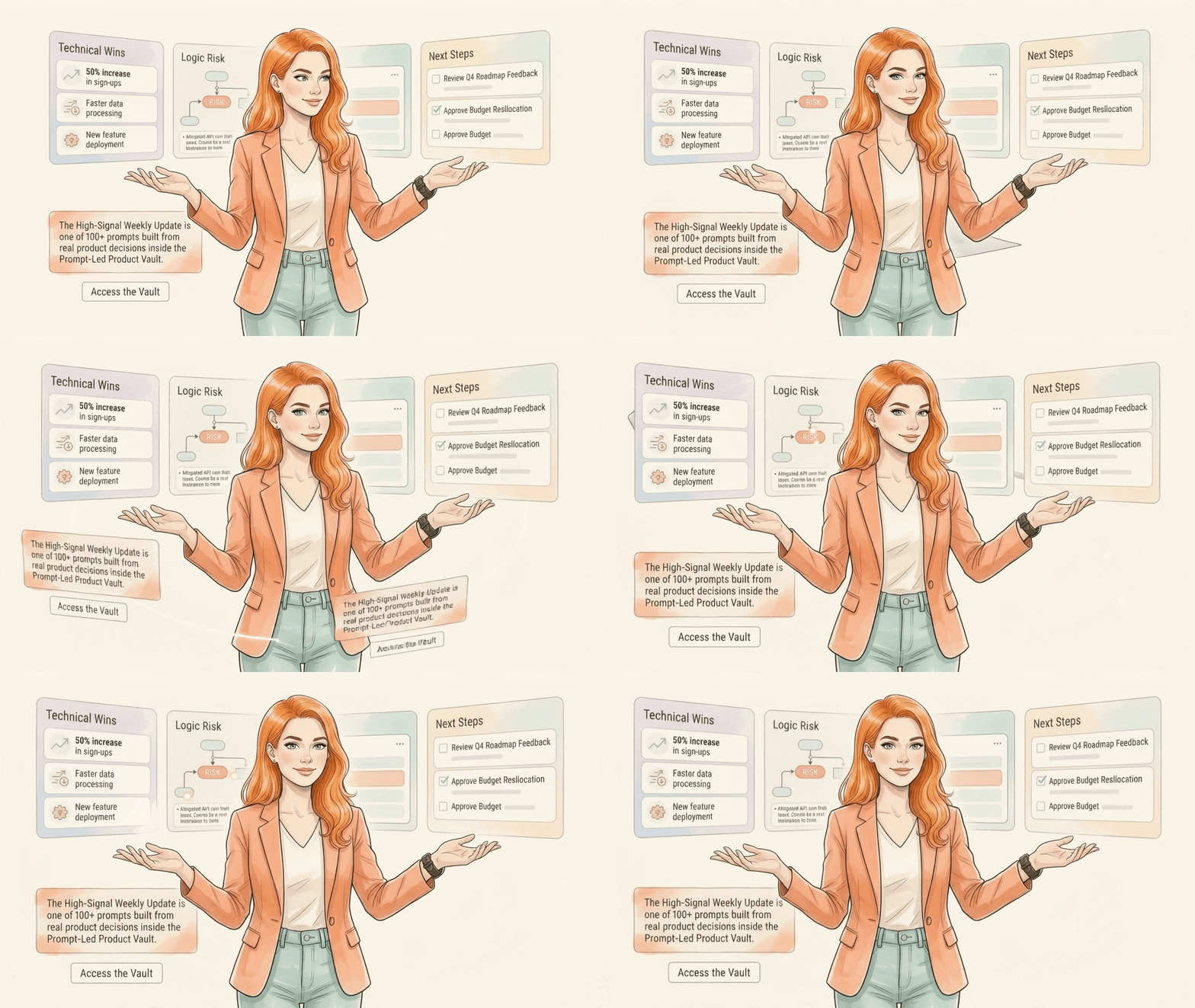
This prompt maps one output to each of those three questions: Technical Wins, Logic Risk, and Next Steps. Every field earns its place. Every field eliminates a follow-up question.
The Logic Risk section is the one most PMs skip. It’s also the one that builds the most trust. When you surface a risk proactively and explain how you handled it, you shift from task reporter to technical lead. Stakeholders stop scheduling “quick syncs” to find out what’s really going on, because you already told them.
When I started including Logic Risk in my DraftKit updates, my stakeholders stopped requesting follow-up calls. That one field change saved me an average of one unplanned meeting per week.
The Prompt
Role: Strategic Communications Lead / AI PM.

Context:
- Product: [App name and one-sentence description]
- Stakeholder Type: [e.g., investors / engineering lead / cross-functional team / executive]
- Current OKR or Goal: [The metric or outcome you are working toward this period]
- Raw Data: [Insert Jira Export / Slack Summary / sprint notes]

Task:
1. Identify the 3 most significant Technical Wins this week that
   directly impact the current OKR or user value.
2. Summarize 1 Logic Risk we encountered and how we resolved
   or are mitigating it.
3. Name 1 thing we deliberately chose NOT to do this week and why
   it was the right call for the roadmap.
4. Draft a 3-paragraph update calibrated to the Stakeholder Type above:

   Paragraph 1 (Intent): What we set out to accomplish this week
   and why it mattered relative to the current goal.

   Paragraph 2 (Velocity): What we shipped, fixed, or decided.
   Frame each item against the Current OKR so progress is
   immediately legible. One specific metric or observable outcome
   per item.

   Paragraph 3 (Next Steps): If a decision or action is needed
   from the reader before [date], state it clearly and name what
   is at risk if it is delayed. If no action is needed, write one
   sentence on what the team is heads-down on next week.

Constraints:
- Total length: under 200 words.
- No bullet lists. Write in complete sentences.
- Do not include any item that is still in progress with no
  observable outcome this week.
- Match the register and technical depth to the Stakeholder Type.
How to Run It
Open Claude before you start your Friday update window. Paste in your Jira export or key Slack thread, add your current sprint goal at the bottom, and run the prompt.
Read the output. Add one specific metric you know wasn’t captured in the raw data. Send it.
The 200-word cap is the constraint that makes everything else work. If the AI produces more, prompt it to cut. If your stakeholders have to scroll, you have already lost them. A brief they read in 60 seconds builds more trust than a report they bookmark and never open.
I run this every Friday for DraftKit. The time savings alone is roughly 90 minutes per week. Over a quarter, that is a full workday returned to building.
Find More Prompts Like This
This prompt is part of the Prompt-Led Product Vault, a growing library of battle-tested prompts I use when building AI products, auditing existing ones, and leading technical PM decisions.
Every prompt in the Vault comes with useful examples, the logic behind the structure, and a real usage example.
Why This Is a Structural Advantage
Most PMs treat their weekly update as a chore they push through before the weekend. The ones who treat it as a product win something more valuable than time.
They earn the trust that turns into autonomy. When stakeholders consistently receive a brief that tells them exactly what they need without requiring a follow-up, they stop pulling you into meetings. They stop second-guessing the roadmap. They give you room to build.
In 2026, the PM who communicates at the speed of their product is the one who gets to keep shipping. A 10-minute update that takes 60 seconds to read is not just efficient. It is a signal that you operate like a technical leader, not a status reporter.
That gap is exactly where high-agency PMs pull ahead of the rest of the field.
I get a handful of reports on Friday afternoons from PM"s and others in the organization. I can say as the recipient, the one I can review in 60 seconds or less and understand the speed and blockers, is the one that gets my attention.
A report earns its place when it helps someone make a decision. Clear communication starts with what the reader needs next.