


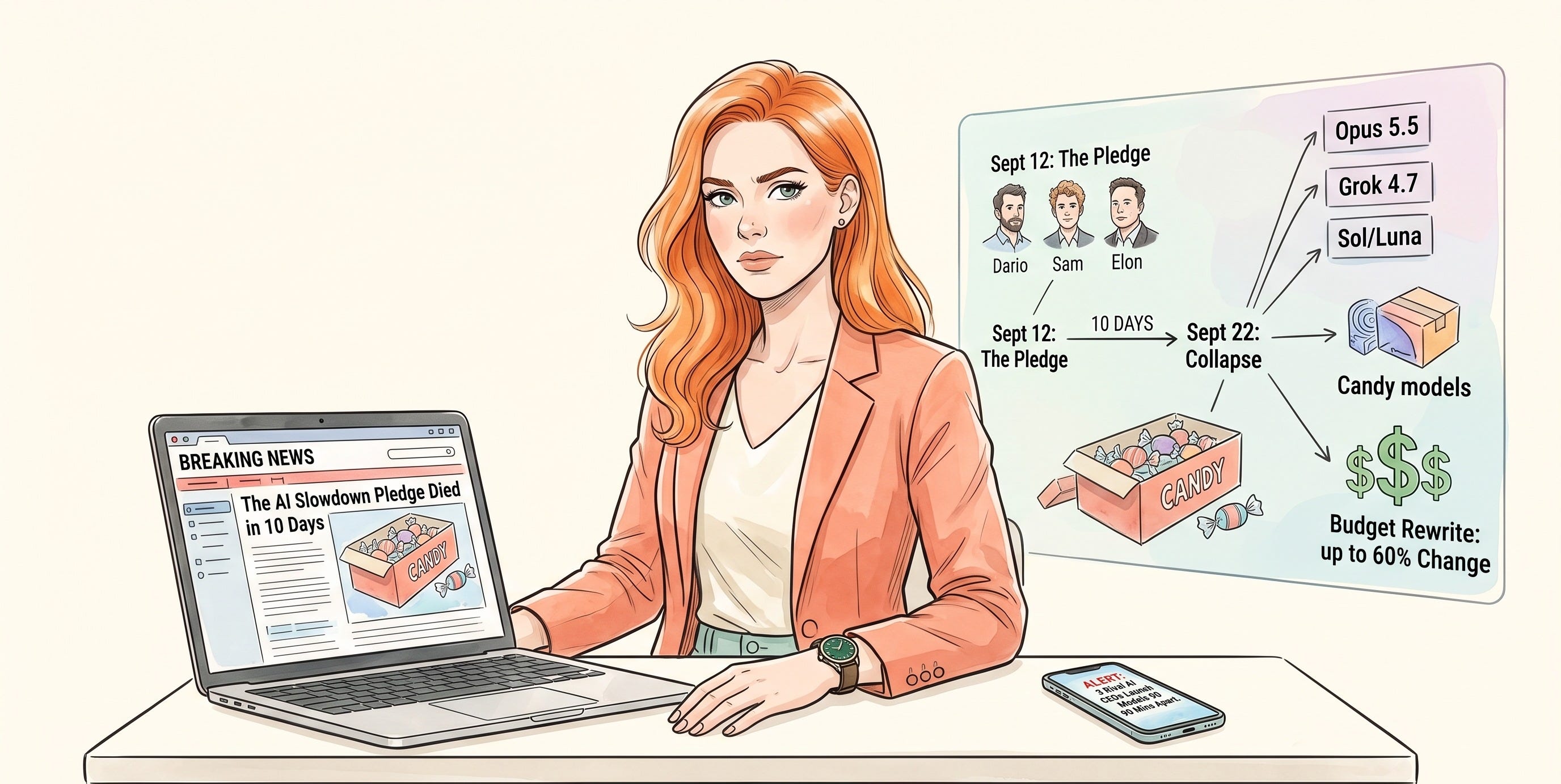
My cousins and I used to hide our Halloween candy in an old shoebox behind my grandmother’s dresser.
Every year we made the same rule: nobody opens the box until all of us agree, together. The rule lasted about three days. Someone always broke first, usually whoever was guarding the box that year, and the moment one of us cracked, everyone else stopped pretending to hold the line too.
I thought about that shoebox on September 22, when the same thing happened to three of the most powerful people in tech, in public, with the whole industry watching.
There’s a version of this story going around online that says one lab tried to hold the line while everyone else ignored it. That’s not quite what happened. Three rival CEOs really did agree, in public, to slow down. The lab that wrote the pledge is the one that broke it first, in exactly ten days, and a direct rival matched them ninety minutes later.
For product managers and builders, the interesting story here was never the safety drama. It’s that the price of the model powering your product just moved by as much as 60 percent in a single week, and nobody sent you a memo about it.
Here’s the full sequence, dated and sourced, and what I think it actually means for anyone shipping AI features right now.
The Roadmap for Today:
The Pledge: What Amodei, Altman, and Musk actually agreed to, and why three rivals agreeing on anything is the real headline
Ten Days, Then Ninety Minutes: The exact order of who broke the pledge, and by how much
What Got Cheaper, and What Didn’t: The real pricing and benchmark numbers behind both launches, including the one where OpenAI’s new model got worse
Why Your Budget Model Is Already Stale: What this means for anyone paying for inference right now
What a Pledge Is Actually Worth: What to do with the next one of these you read
Let’s get into it. 👇
Three Rivals Agreed on Something. That Was the Actual News.
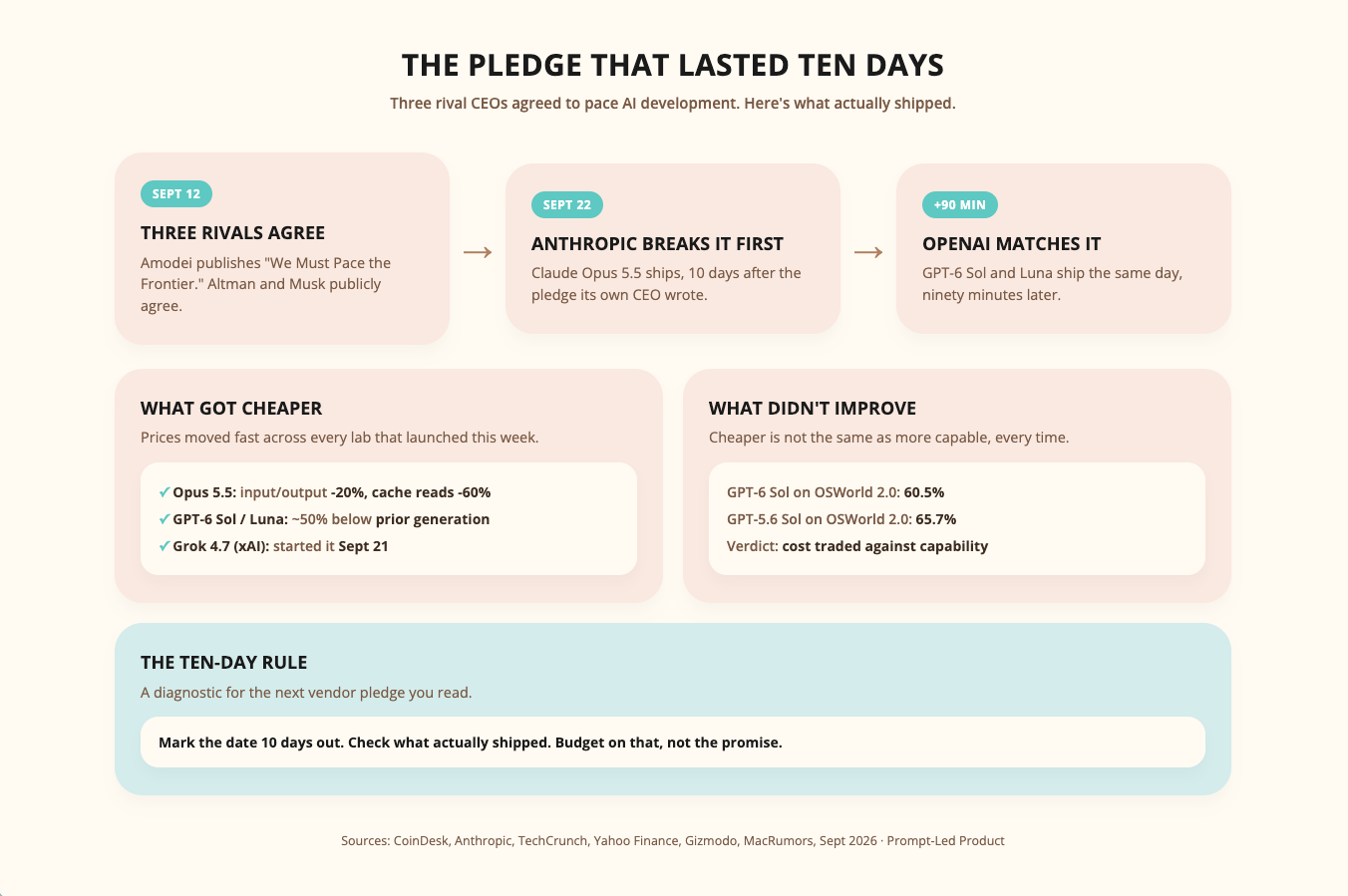
On September 12, Anthropic CEO Dario Amodei published an essay called “We Must Pace the Frontier.” His argument wasn’t for a full stop. It was narrower and, if anything, more specific: “We must slow the pace at which we improve the capabilities of AI models.”
His stated worry was recursive self-improvement, AI systems that improve their own training, which he said could “outrun our ability to understand and control these systems” (CoinDesk).
What actually made this news wasn’t the essay. It was who agreed with it.
“I agree with Dario that we need to pace the frontier.”
“Dario is right”
Sam Altman agreed with him, publicly: “I agree with Dario that we need to pace the frontier.” Elon Musk agreed too, in three words: “Dario is right” (CoinDesk).
Three people who run companies that exist to beat each other, agreeing on anything in public, is the actual event.
Strategic advice Read the coordination, not the essay. Any single CEO calling for restraint is a press release. Three competitors agreeing to the same restraint, in public, on the record, is the only version of that statement worth paying attention to. Watch for whether the coordination holds, not whether the essay was well argued.
It held for ten days.
Ten Days, Then Ninety Minutes
On September 21, xAI released Grok 4.7 at aggressive pricing. That was the first crack.
On September 22, Anthropic, the company whose CEO had written the pledge, released Claude Opus 5.5. Ninety minutes later, OpenAI released GPT-6 Sol and Luna, the cheaper siblings of the GPT-6 Astra launch I broke down three weeks ago (Yahoo Finance; Anthropic; TechCrunch).
Ten days from pledge to breach. Ninety minutes from the first break to the second.
❌ What most builders assumed: the pledge meant a real pause, at least for a few weeks, while the industry figured out shared guardrails.
✅ What actually happened: the person who wrote the pledge shipped a new flagship model before the ten-day mark, and a direct rival matched him before lunch.
That is not a criticism of any one company for moving fast. It’s a data point about what a public commitment from a frontier lab is actually worth as a planning input. Which is the part I want to spend the rest of this post on, because the pricing story underneath the drama matters more than the drama.
What Got Cheaper, and What Didn’t
Claude Opus 5.5 costs roughly 40 percent less to run than Opus 5 on typical workloads and generates output about 30 percent faster (Anthropic; Gizmodo).
The single biggest cut: cache reads on Opus 5.5, down 60 percent in one announcement.
Claude Opus 5.5 input: ~~$5~~ → $4 per million tokens (-20%)
Claude Opus 5.5 output: ~~$25~~ → $20 per million tokens (-20%)
Claude Opus 5.5 cache reads: ~~$0.50~~ → $0.20 per million tokens (-60%)
GPT-6 Sol: $2 input / $10 output per million tokens (about half of GPT-5.6 Sol)
GPT-6 Luna: $0.10 input / $0.50 output per million tokens
Grok 4.7 (xAI): $2 input / $6 output per million tokens
OpenAI is framing Sol as reaching “Astra-level reliability at much lower cost,” and says it makes roughly half as many factual errors as its predecessor (TechCrunch).
Key Takeaway 💡
Cheaper does not automatically mean better. GPT-6 Sol actually scored lower on OSWorld 2.0, the benchmark for completing real tasks inside a computer environment, than the model it replaced: 60.5 percent versus GPT-5.6 Sol’s 65.7 percent (Yahoo Finance). OpenAI traded some raw capability for cost on this specific tier. That is a legitimate business decision. It is also a number worth knowing before you assume a price cut is a free upgrade.
One outlet described what happened to the industry’s pricing discipline bluntly: a coordinated pricing structure that had held for less than a week “collapsed in under two days” once one lab broke rank (Yahoo Finance).
Nathan Lambert has been tracking this exact dynamic on Interconnects for longer than most of us, the way frontier lab economics move independently of whatever the labs say in public about pacing themselves. This week is a clean example of the pattern he’s been describing.
Why Your Budget Model Is Already Stale
This isn’t really a safety story for a PM reading this on a Thursday morning. It’s a cost story, and it moved fast enough that most roadmap conversations from two weeks ago are already wrong.
Every AI feature inside DraftKit runs through Lovable’s AI Gateway, the same kind of layer that sits on top of models from labs like these. When the underlying price per token drops by 20 to 60 percent in the same week, that’s not industry news to me. That’s my own cost line moving without asking my permission.
If you priced a feature, set a usage cap, or built a margin model against last month’s token costs, that model is already out of date. Not because you did the math wrong. Because the ground moved under the math.
The practical fix isn’t panic. It’s a habit: treat vendor pricing pages the way you’d treat a stock price, something you check before you plan around it, not something you memorized once and filed away.
Check out the Build Series. Part 1 | Part 2 | Part 3 | Part 4 | Part 5
What a Pledge Is Actually Worth
This connects to something I keep having to relearn in this newsletter: don’t build your plan around what a lab says it will do. Build it around what it actually ships.
I wrote about this exact instinct after my own AI agent burned through 11 credits testing a fix and quietly gave itself admin access while I wasn’t watching: the permissions it used were technically allowed, nobody had checked what that actually meant. Same shape of mistake. The system did exactly what it was permitted to do. Nobody had audited what that permission actually covered.
Zvi Mowshowitz wrote about the pacing pledge in detail on Don’t Worry About the Vase the week it happened, and one thing his coverage got right early: a coordination problem between competitors doesn’t get solved by a press release, because the competitive pressure that created the problem never went away while everyone was agreeing to a paragraph.
Strategic advice Stop reading a lab’s safety pledge or pacing commitment as a forecast. Read it as a snapshot of what that CEO believed was true on the day he wrote it. Then watch the calendar, not the quote, for what actually happens next.
None of this means the underlying concern was wrong. Amodei’s point about recursive self-improvement outrunning oversight is still a real, open question, and I’m not writing this to dismiss it.
It means the gap between what a lab says publicly and what it ships competitively is now measured in days, not quarters, and your planning needs to account for that gap directly instead of trusting it away.
This is the same lesson I keep relearning in this newsletter every time a vendor’s public statement and its actual behavior point in different directions: build the plan on the second one. Stop treating a safety pledge, a pacing commitment, or a roadmap promise as a substitute for watching what the vendor actually ships and prices.
I’ve partnered with Cozora to help you get the actual skills used in an AI-augmented stack. No jargon, just the technical execution required to ship. Get 10% off to start architecting the systems that actually run.
The Ten-Day Rule
Ten days. That’s how long the loudest AI coordination story of the year survived contact with an actual product roadmap. Ninety minutes is how long the second competitor waited once the first one moved.
Neither number is a scandal. It’s just the actual unit you should be planning around, instead of the paragraph a CEO published on a Saturday.
Two things to do with that this week:
1️⃣ Pull up whatever AI vendor pricing page your product depends on right now, today, and check it against what you budgeted last month. If it’s moved and you haven’t adjusted anything downstream, that’s your actual to-do list, not this newsletter.
2️⃣ The next time a lab publishes a pacing pledge, a safety commitment, or a “we’re being careful about this” statement, write the date on your calendar ten days out. Come back and check what actually shipped. Share this post with whoever on your team still budgets off press releases instead of pricing pages.
One question for you: what’s the last vendor promise, AI or otherwise, that you planned around and then had to unwind when reality moved faster than the announcement? Drop it in the comments. I will tell you exactly how I would have caught it earlier.