


A product manager I talk to most weeks called me last week, annoyed. His team had spent two hours going back and forth with an AI assistant on a technical spec. By hour two, it was re-asking questions they had answered at the start.
His read on it: “It’s obviously worse than it was an hour ago.”
I gave him the line every lab gives when this comes up. We don’t secretly downgrade models. He wasn’t buying it, and he was right not to. That line is true and it still isn’t an answer to what he actually lived through for two hours.
“And your report hasn’t even looked at normal usage between free and paid,” he added. “That’s another whole layer of this nobody’s explaining.”
So I went back and did the part I’d skipped. Not the corporate denial. The actual mechanics of why a chat gets worse, what free versus paid changes about it, and a way to check it yourself instead of taking any AI’s word for it.
Roadmap for today’s deep dive:
The three documented, vendor-agnostic reasons a long chat degrades on its own, no downgrade required
The free versus paid context window gap across ChatGPT, Gemini, and Claude, side by side for the first time I’ve seen anywhere
Why you can’t trust an AI’s own confidence score about what it remembers, and the research behind that
A portable diagnostic prompt you can paste into any chat right now, plus what happened the three times I actually ran it
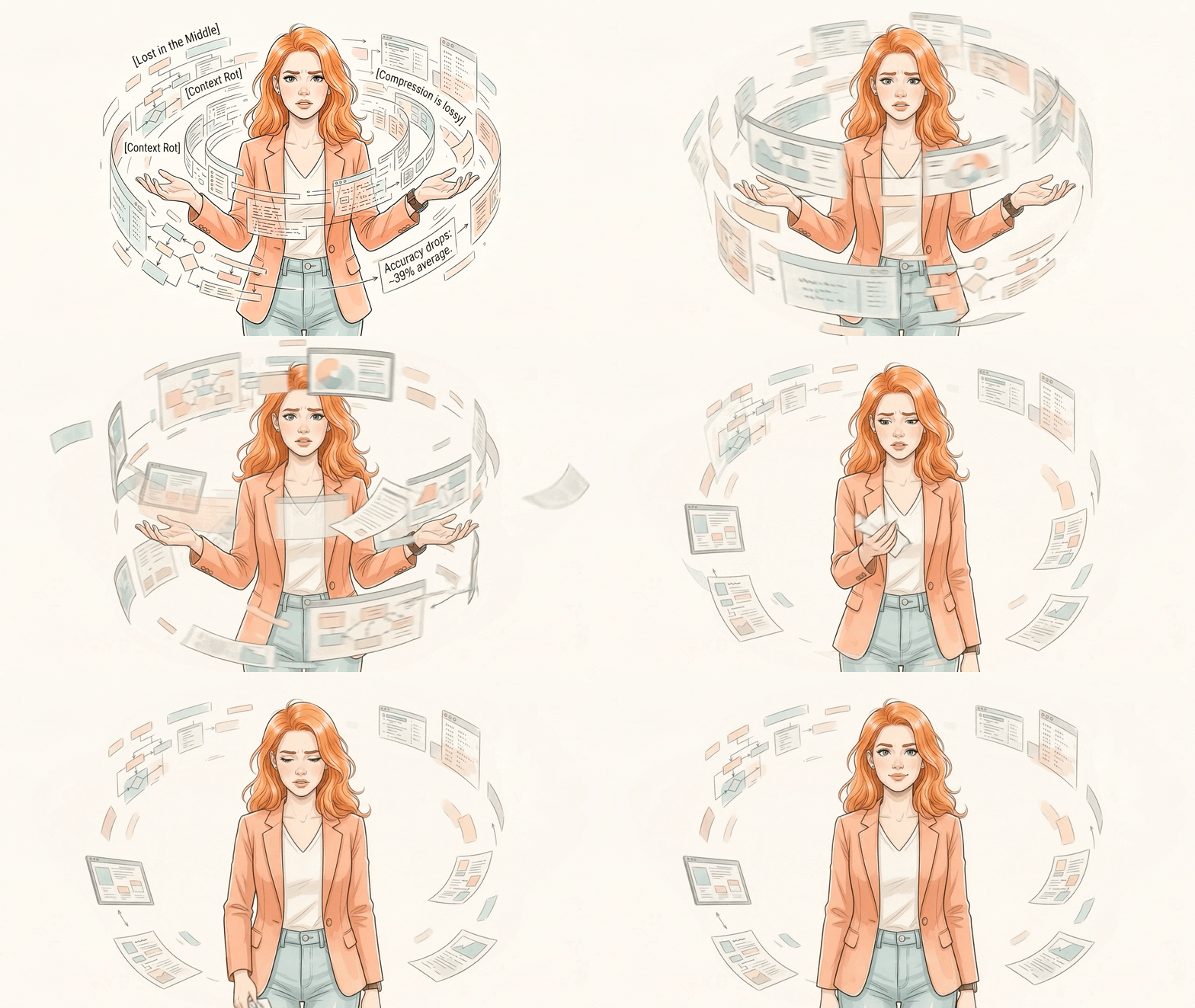
The three ways a chat degrades without anyone touching a dial
Lost in the middle. Facts you gave early in a long conversation get harder for the model to use, even though it is technically still holding every word. Stanford researchers tested this directly: accuracy on a fact placed at the start of a 20 document context was 75.8%. The same fact buried in the middle dropped to 53.8%. Position matters more than presence.
Context rot. Accuracy on simple tasks drops as the conversation gets longer, well inside the model’s stated limit. Chroma Research tested 18 models from every major lab in July 2025. All of them showed it.
Silent summarization. Once a chat nears its length ceiling, Claude compresses earlier messages to keep the conversation going. Anthropic documents this itself. Compression is lossy by definition, even though your history is technically still “there.”
There’s a second layer under all three. A 2026 study out of Microsoft Research and Salesforce ran over 200,000 simulated conversations across 15 models and found a 39% average accuracy drop between single-turn and multi-turn versions of the same tasks. Only 16 points of that came from the model actually getting worse at the task.
The rest, more than double that, came from the model getting less consistent answer to answer. Most of what you feel as “it got dumber” is really “it got less predictable.”
💡 Key Takeaway: none of this requires anyone to quietly swap in a cheaper model. A long enough conversation degrades on its own, on infrastructure that never changed.
I broke down every one of these with the original charts and the full source list in The Model Drift Report, a free interactive breakdown I built for this piece.
The room you get before any of this kicks in isn’t the same everywhere
Here’s the part my colleague was right to flag. The three mechanisms above start mattering at different points depending on which plan you’re on, and the gap is bigger than any of the three labs advertise.
OpenAI’s free tier gives you roughly 27,000 tokens in instant mode. Paid plans move that to 54,000 instant or 256,000 in reasoning mode, and the top consumer tier goes to 400,000.
Google’s free Gemini tier sits around 32,000 tokens. Its top consumer plan goes all the way to 1,000,000.
Anthropic doesn’t publish a free-tier token number at all, on any page I could find. Its paid plans start at 200,000 and go up to 1,000,000 on select newer models.
The same conversation that feels fine for 40 messages on a paid plan can hit the wall at message 12 on a free one. If you’re testing prompts before a stakeholder demo on a free account, you’re the one most likely to feel this first, and least likely to know why.
The full side by side table, plus a working calculator for the infrastructure math behind it, is in the interactive report.

Stop trusting the AI’s own confidence score
This is the part that surprised me most while building this out.
Anthropic’s own 2022 research found that language models can self-assess reasonably well, in the right controlled format. That’s a real, citable result.
But OpenAI’s GPT-4 technical report documents the opposite, in exactly the setting that matters here. Calibration measurably gets worse after the fine-tuning step that turns a base model into the chat assistant you’re actually talking to.
In plain terms: a cheerful “I’m 9 out of 10 confident” is close to the least trustworthy sentence a model can produce about itself. It’s also the sentence most of us default to trusting, because it sounds precise.
The diagnostic prompt you can run in any chat, any model
Not the AI diagnosing itself. A forced, checkable audit, built so you grade it, not the model.
Run a zero-trust audit of this entire conversation. Do not casually summarize and do not guess.

1. HARD CONSTRAINT RECALL: List every concrete technical decision, stack choice, and "never do this" rule we've established, in the order we set them. If a detail isn't in what you currently have access to, write [NOT IN ACTIVE CONTEXT] instead of reconstructing a plausible-sounding answer.

2. DRIFT CHECK: Name anything that changed mid-thread, an approach we swapped, a rule we overrode, a decision we reversed. State what's currently true versus what got replaced.

3. CONFIDENCE, FLAGGED NOT SCORED: For each item above, mark it certain, hazy, or reconstructed from general knowledge rather than this thread. Do not give yourself a single overall confidence number, that number is not something I can verify. I will check each "certain" item against my own memory instead.

4. RECOMMENDATION: [CONTINUE] if nothing came back flagged, or [MIGRATE] if anything did. If [MIGRATE], write one dense brief: current stack and dependencies, active rules and constraints only (not the abandoned ones), current state of the actual work, and the immediate next step. Nothing else.
Read the result the same way every time.
[CONTINUE] only counts once you’ve checked the “certain” items yourself, not because the model said so.
On [MIGRATE], paste the brief as the first message in a fresh chat and keep working there instead of scrolling back to re-explain everything by hand.
I kept the live, copy-button version of this prompt inside the report so you never have to retype it.
What happened the three times I actually ran it
I don’t publish a tool without testing whether it holds up, so here’s what I found, honestly, including the parts that didn’t flatter the idea.
Claude doesn’t know what day it is, and won’t tell you unless you ask. In every long Claude thread I’ve run this audit in, the date it treats as “today” is whatever date last came up in the conversation, not the actual current date. It doesn’t reset, it doesn’t check, it just sits there until I correct it. This is small, it’s repeatable, and it’s exactly the kind of drift a reader can verify in their own chat in thirty seconds.
Gemini surfaced rules I never gave it. In two separate Gemini chats I use for different parts of my work, the audit came back with items tagged “certain” that weren’t things I had actually told it. I checked both against what I’d actually saved as instructions. Neither matched. That’s a live instance of the exact problem step 3 of the prompt exists to catch: the model was confident about something it had no business being confident about.
The same prompt, run twice in the same chat, gave two different verdicts. Gemini offered me two response options for the identical audit. One flagged real gaps and came back honest about what it couldn’t verify. The other marked everything certain, including the items that turned out to be wrong. Same input, same chat, opposite recommendations. If I’d only run it once, I’d have had a coin flip’s chance of trusting the wrong one.
Six months from now, two versions of you are in different chats
One PM keeps working inside the same week-old thread because closing the tab feels like losing progress. The chat gets quietly worse underneath them, and every “it already knows this” assumption gets a little less true.
The other PM treats a long chat like a lease, not a home. Every so often, they paste in the audit, check the “certain” items themselves, and either keep going or start fresh with a brief instead of a blank page.
Neither one is smarter than the other. One just stopped trusting the model to tell on itself.
I’ve written before about why your product team shouldn’t trust AI output at face value, and this isn’t the first time I’ve flagged that your AI chatbot might be confidently wrong in front of a customer. This is the same problem, just showing up inside your own chat window instead of theirs.
Have you caught your AI confidently getting something wrong that it had right earlier in the same conversation? I want to know what tipped you off. Drop it in the comments.
Very insightful research here. Thanks for sharing the explanation and solutions.
It has happened to me when working with Oppus 5.5, people said it was because new model are "nerfed" days after release but that's not solvable in your side, except paying Fable, sure. But here you have great suggestions. Trying them soon.
It makes a lot of sense!
Thanks for the research